DEAR DANKO
EXPERT GROW ADVICE
LEAF COLOR FADING DURING FLUSH, BIGGER YIELDS, ODOR CONTROL, ALGAE ON ROCKWOOL AND MORE...
DEAR DANKO
EXPERT GROW ADVICE
LEAF COLOR FADING DURING FLUSH, BIGGER YIELDS, ODOR CONTROL, ALGAE ON ROCKWOOL AND MORE...
SUBJECT: Fall Flush and Fade
FROM: Terpene Cowboy
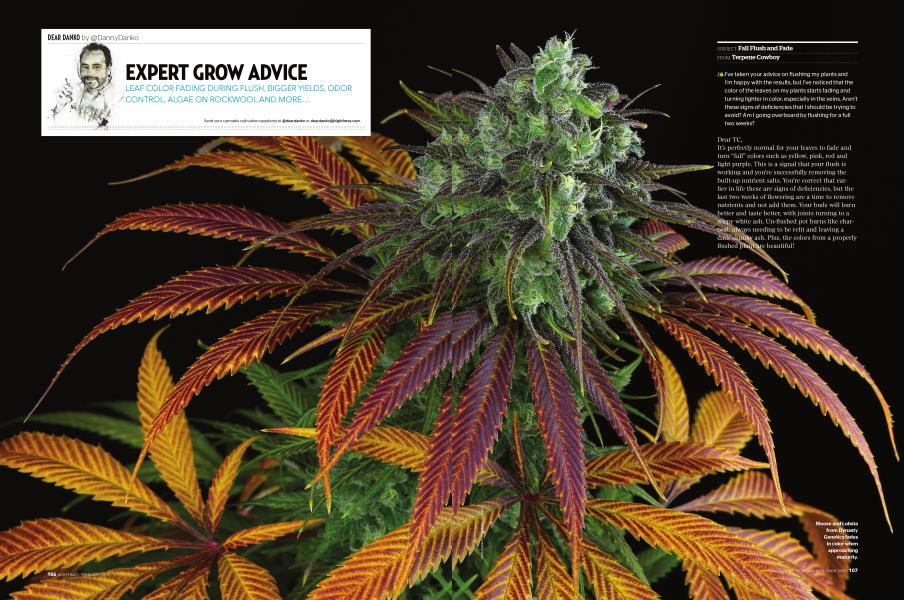
I've taken your advice on flushing my plants and I’m happy with the results, but I’ve noticed that the color of the leaves on my plants starts fading and turning lighter in color, especially in the veins. Aren’t these signs of deficiencies that I should be trying to avoid? Am I going overboard by flushing for a full two weeks?
Dear TC,
It’s perfectly normal for your leaves to fade and turn “fall” colors such as yellow, pink, red and light purple. This is a signal that your flush is working and you’re successfully removing the built-up nutrient salts. You’re correct that earlier in life these are signs of deficiencies, but the last two weeks of flowering are a time to remove nutrients and not add them. Your buds will burn better and taste better, with joints turning to a wispy white ash. Un-flushed pot burns like charalways needing to be relit and leaving a dark chunky ash. Plus, the colors from a properly flushed plant are beautiful!
Danko Tip: Wet trimmed material that's frozen after harvest works better for hashmaking than dry, room-temperature trim.
SUBJECT: Wider Plant FROM: Jenn M.
This is the first time after four tries that I actually got a plant into the vegetative stage. I live in New York and I don’t have the funds to build or buy the supplies needed for indoor growing right now. The first year, my germinated seeds were eaten by a bird. The next year, I moved and my plant didn’t like it, and last summer I ended up with a boy. I’m fairly certain I have a girl right now, but my plant is not growing out so much as it is growing tall. I know from experience that it’s not a boy because there are no balls growing. How can I fatten her up before the summer comes to an end? Also, do I have no other choice than to bring the plant inside and make a small growroom to better control the flowering stage? And one more thing: What do I do with the plant after I harvest the buds? Does it get tossed out, or can I use the same plant over and over again?
Dear Jenn,
If you want your plant to get wider, you have several options. The first is to top or train the plant so that it spreads out. This entails cutting off or bending the main stalk of the plant in order to get the other branches to grow bigger. Think of your plant’s natural tendency to grow like a Christmas tree, with one main stem and smaller secondary ones. When you remove or lower the main top branch, the other ones become main branches, and your plant will have many tops instead of just one. This will dramatically increase your overall yield come harvest time.
You do not have to bring the plant indoors to flower unless your area is threatened by frost. Plants in most of New York State can remain outside until early to mid-October, and most strains (aside from extremely long-flowering sativa-dominant ones) should be finished flowering by then. If you think they may get too cold before they’re finished flowering, bring them inside or cover them with a hoop house or greenhouse structure of some kind for the duration.
After you harvest, discard the rest of the plant and start over in the spring. It’s possible to keep your plant alive through the winter and regrow it again, but it’s best to begin again with new seeds or clones. Cannabis is an annual, meaning it’s naturally meant to grow from seed in one season, producing seeds that will fall and emerge to grow out for the next season.
SUBJECT: Flower Fast FROM Andrew P.
In an indoor grow, when do you think is the earliestthat I could flower a plant? Isthe proper timing based on height or age—or both? This question is for either feminized plants or those from regular seeds (not auto-flowering). There seems to be a lot of conflicting information online.
Danko Tip: Plants that grow crowded together are far more likely to develop molds and diseases.
Dear Andrew,
Indoors, a plant will flower solely based on how much light you give it per day. Even a newly rooted cutting or a seedling that’s only recently emerged from the soil can be forced to flower under 12 hours of light per day. The problem is, without much of a root system to sustain growth and aid in cell development, the yield from these plants will be minuscule. I usually recommend at least a 2-week period of vegetative growth (under 18 hours of light per day) before forcing dowering. The longer the vegetative period, the bigger the root system can grow and the bigger the plants will get, which will give you a much larger harvest in the end.
SUBJECT Light Switch FROM: Regina
I was wondering if I can start off my pot plants under a T5 fluorescent light during the vegetative stage and then put them under mercury/high-pressure sodium lights. They are only seedlings about 2 inches tall. A friend told me I wasn’t using enough light.
Dear Regina,
Absolutely! Many people do this to save money on electrical costs and because they can lower the duorescents closer to their seedlings and vegetating plants. Young plants are sensitive to the intense heat given off by HID (high-intensity discharge) lighting such as MH (metal halide) and HPS (highpressure sodium). You can even dower under duorescent lighting, but you won’t get yields as big as you would with HID (as long as you’re able to remove heat and create the ideal environmental conditions for your plants).
SUBJECT Charcoal-Filtration Frustration FROM Bitaddict
My question has to do with charcoal filters. How long do they typically last, and is there a way to replenish or recycle them?
Dear Bitaddict,
The life of charcoal biters varies greatly based on size and usage, but a good rule of thumb is not to use them for more than 2 years. Most manufacturers recommend changing them every 18 to 24 months no matter what, but if you have a big room with an exhaust fan blowing through the biter 24 hours a day, you might want to replace the biter every calendar year. The pores of the activated charcoal eventually become hlled with odor particles, moisture, dust and other particulates, limiting the charcoal’s ability to clean the outgoing air.
Danko Tip. Thick organic mulch protects outdoor plants from drying out too quickly and keeps weeds from competing for sunlight.
Rather than replacing and repacking the new activated charcoal yourself, I recommend purchasing a replacement filter and installing it according to the manufacturer’s instructions. Unless you’re an expert in how to pack the filters properly without creating air pockets, do yourself a favor and stick with a replacement filter.
SUBJECT Feeding Schedule FROM: JustinS.
Are there certain times during a plant’s life in which it wants to be fed more nutrients, or should you always feed about half of what the label says? I’ve heard so many differing opinions, and I’d like to get a definitive answer.
Dear Justin,
Yes, plants have different nutritional requirements at different times during their life cycles. During its vegetative stage, a plant will need more high-nitrogen food after a few weeks of growth than when it first goes into its container. As the plant develops a bigger root system and the stem, branches and leaves grow larger, it will require higher levels of nutrients added to the solution with which you’re feeding it.
During the flowering stage, the plant will need more food from week 2-5 or so, depending on the flowering time of the strain you’re growing. The early stage of flowering is a transitional phase, during which not much food is required. Once flowers begin forming and growing larger after a couple of weeks, you’ve reached the time to boost the high-phosphorus and highpotassium nutrient levels in your feeding solution. Cut back around the 6th or 7th week of flowering, depending on your strain’s total flowering time, and begin the flushing process of watering with plain water only. This ensures that any remaining built-up nutrients are leached out of the plant matter and the resulting buds will burn properly and taste the way they should.
SUBJECT Green Rockwool
FROM:RUCkO
A friend of mine started some clones with rockwool and noticed mold developing on top of the medium after a few days. How can this be prevented?
Dear Rucko,
One of the advantages of using rockwool as a growing medium is that it stays wet, yet allows oxygen to reach the roots. This can also cause mold and algae to build up on the surface of your cubes, and they in turn begin to compete with your plants for your nutrient solution. Luckily, they need light to live, so if you simply cover the tops of your rockwool cubes with an opaque surface, you’ll eliminate most algae and mold growth on your medium. Some companies make products specifically for this purpose. One that comes to mind is the Cubecap (cubecap.cct). Covering your cubes also has the added benefit of discouraging annoying fungus gnats as well.